Rooibos, also known as red bush tea, has a reputation for being the gentle, naturally caffeine-free alternative to traditional tea. Its botanical name is Aspalathus linearis, a shrub associated with South Africa’s Cederberg region. The familiar red-brown version is the one most people recognise, but there is another form that stays green because it is processed without the oxidation used to create traditional rooibos. The two are therefore less like different teas and more like two expressions of the same plant.
That creates an easy point of confusion. If both come from rooibos, why does one taste soft and honeyed while the other can seem greener and more vegetal? The answer is sitting in the process, and it also explains why choosing between them is not simply a matter of picking the “healthier” colour.

The colour change tells a bigger story
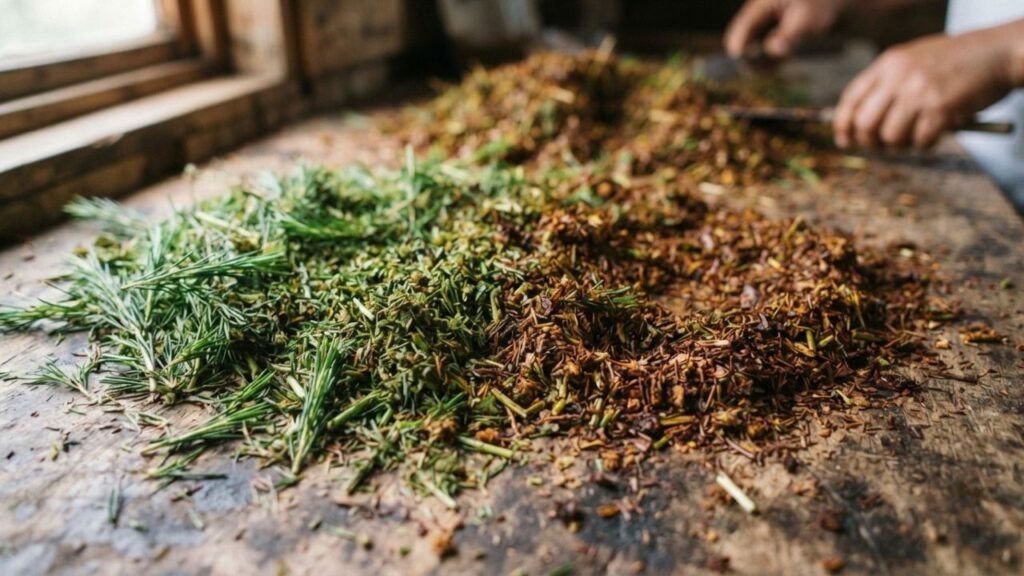
Traditional red rooibos begin life much closer to green rooibos than its finished colour suggests. After harvesting, the plant material is cut and bruised and allowed to oxidise before drying. The process has historically been called “fermentation,” although oxidation is a more accurate description of what is happening chemically. That change develops the reddish-brown appearance and the characteristic flavour associated with conventional rooibos.
Green rooibos take a different path. The oxidation stage is prevented, leaving more of the plant’s original green character intact. This is not a cosmetic distinction. Research into rooibos chemistry shows that oxidation changes the plant’s phenolic compounds, including aspalathin, one of the compounds particularly associated with rooibos.
So the first useful distinction is simple: red rooibos is oxidised; green rooibos is not.
Why red rooibos tastes familiar
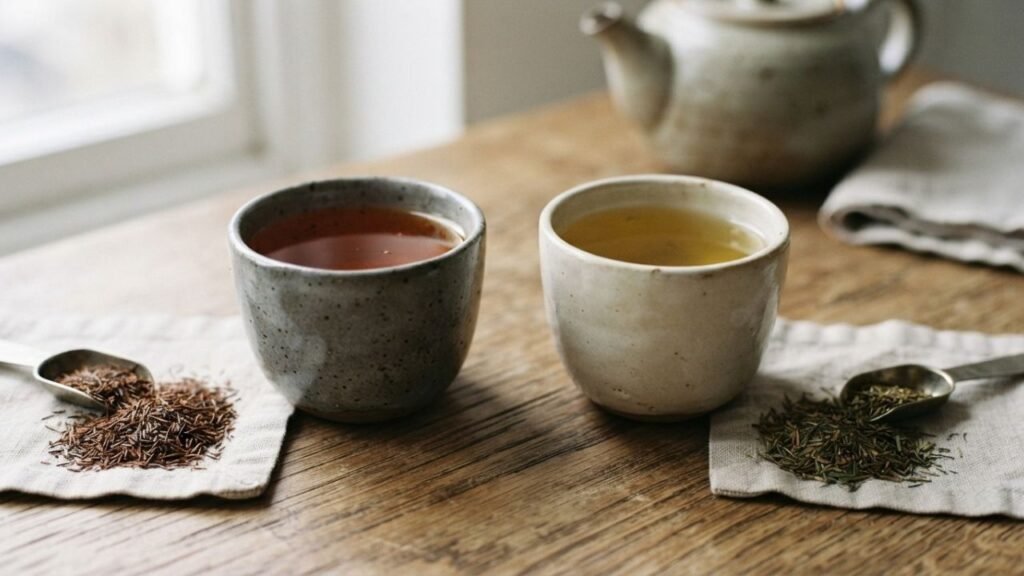
Red rooibos has the flavour profile most people associate with the word “rooibos”, soft, slightly sweet, woody and sometimes reminiscent of honey or caramel. Sensory research has identified woody, honey, herbal-floral and caramel-like notes among the characteristic qualities of rooibos.
Oxidation is a major reason for that character.
As the plant’s compounds react during processing, its flavour moves away from the fresher, greener qualities of the unoxidised leaf. The result is a darker, rounder drink that tends to feel more settled on the palate.
This is also why red rooibos are often the safer choice when someone is trying rooibos for the first time. It has a familiar warmth without tasting exactly like black tea or green tea.
Green rooibos keeps the sharper edge
Green rooibos are more revealing.
Without the oxidation stage, the flavour remains closer to the character of the plant itself. It can have grassy, hay-like or vegetal notes and a more pronounced sense of freshness. Research comparing the sensory profiles of the two forms has found green rooibos to be more strongly associated with plant-like and grassy characteristics, while fermented rooibos carry sweeter, woody and honeyed notes.
That difference can divide people quickly.
Someone who enjoys delicate green teas or fresh herbal flavours may find green rooibos more interesting. Someone expecting the soft sweetness associated with rooibos may find it less immediately appealing.
Neither reaction means the tea is better or worse. They are simply different sensory expressions of the same raw material.
The “green means healthier” idea needs some caution
This is where rooibos comparisons often become too simplistic.
Green rooibos do retain higher levels of certain compounds that are reduced during oxidation, particularly aspalathin. Research has documented substantial changes in the phenolic profile as rooibos move from unoxidised green material to traditional red rooibos.
That is a real difference.
But it does not automatically make green rooibos the better everyday choice, nor does a higher concentration of a particular compound tell us everything about what drinking the finished beverage will do in a person.
Human research on rooibos is still relatively limited, with studies using different forms, amounts and populations. Reviews of the evidence have specifically noted the need for larger human studies.
For choosing a tea, then, it is more sensible to treat the chemical difference as one point of distinction, not as a reason to turn the two colours into a health contest.
A better way to choose between the two
The easiest mistake is choosing based on the colour alone.
Instead, think about the experience you want from the cup.
- For a softer, rounder flavour: red rooibos is the natural starting point.
- For a fresher, greener flavour: green rooibos is more likely to suit you.
- If you dislike grassy or vegetal herbal teas: red rooibos will probably be the less challenging option.
- If conventional red rooibos taste too sweet or woody: green rooibos give you a noticeably different direction.
- If the plant’s natural character interests you: green rooibos offer a closer expression of the unoxidised material.
- If you want the classic rooibos experience: red rooibos is the obvious reference point.
The useful question is not “Which one is best?” It is “Which difference actually matters to me?”
What to look for when buying
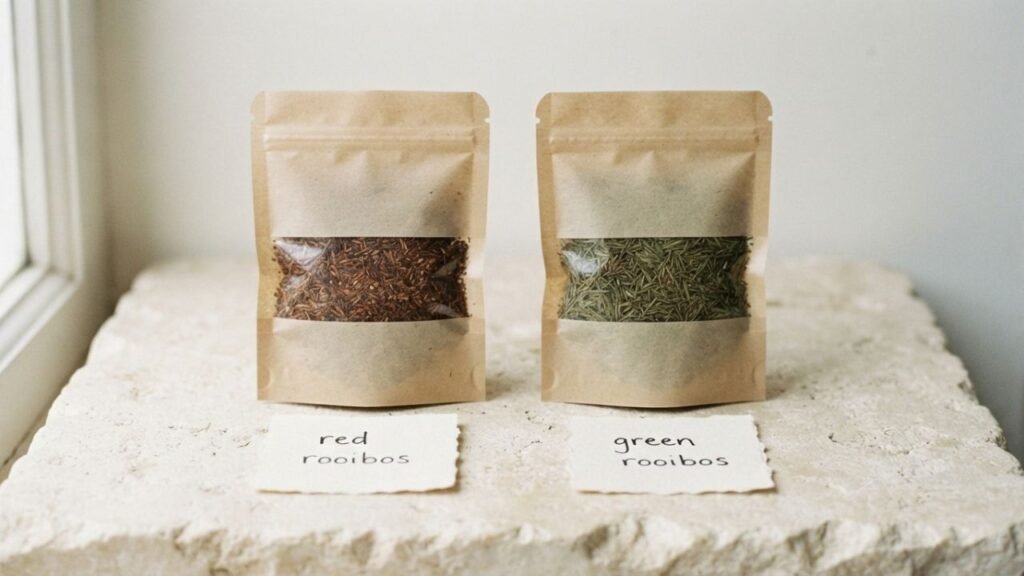
Once you know the distinction, the label becomes much easier to read. Look for red rooibos, fermented rooibos or oxidised rooibos when you want the traditional version. For the greener style, look for green rooibos, unfermented rooibos or unoxidised rooibos.
The word “fermented” can be slightly misleading because rooibos processing is primarily an oxidation process rather than fermentation in the way people might understand it from foods such as yoghurt or fermented vegetables. The traditional terminology has nevertheless remained common in the rooibos industry and research literature.
Also pay attention to whether you are buying plain rooibos or a blend. A box labelled “rooibos” may contain additional herbs, flowers, spices or flavourings, which can make comparisons between products less useful.
If the purpose is to understand the difference between red and green rooibos, start with a plain version of each. It makes the contrast much easier to notice.
The small detail most comparisons miss
There is an interesting reversal at the centre of this whole debate.
Red rooibos looks more natural because its colour feels earthy and familiar. Green rooibos looks more raw because it retains its green appearance.
But the red colour is actually evidence of more processing, not less.
That does not make red rooibos inferior. Processing is precisely what gives it the flavour that made traditional rooibos distinctive in the first place. Without that transformation, you would not get the same red-brown colour or the same honeyed, woody profile.
Green rooibos, meanwhile, is not simply “red rooibos before it turns red.” It is a deliberately produced product in its own right, developed around preserving the unoxidised character and its different chemical profile. Green rooibos entered the commercial market much later than traditional rooibos.
That is perhaps the most useful way to understand the comparison: red rooibos is defined by transformation, while green rooibos is defined by limiting it.
FAQs
1. Are red rooibos and green rooibos the same plant?
Yes. Both are made from Aspalathus linearis. The main difference is how the harvested plant material is processed.
2. Why is rooibos called red bush tea?
“Red bush” refers to the characteristic reddish-brown colour associated with traditional rooibos. Rooibos itself is the commonly used name for the plant and its herbal infusion.
3. Does green rooibos taste like green tea?
Not exactly. Green rooibos can have grassy and vegetal qualities, but it comes from a completely different plant from green tea, which comes from Camellia sinensis. Readers interested in the botanical difference can see Kew’s profile of Camellia sinensis for its classification and natural range.
4. Which has more aspalathin?
Green, unoxidised rooibos generally contain considerably more aspalathin because oxidation reduces the amount present in the plant material.
5. Is red rooibos sweeter than green rooibos?
It tends to be perceived as sweeter and more rounded. Sensory studies associate traditional rooibos with honey, caramel and woody notes, while green rooibos is more strongly associated with grassy and plant-like qualities.
6. Which one should a first-time rooibos drinker choose?
Red rooibos is usually the easier introduction if you prefer mellow, rounded flavours. Green rooibos is worth choosing if you already enjoy fresher, greener herbal flavours.
The choice is really about character
Red and green rooibos are often presented as though one must win the comparison. They do not. The interesting part is how much difference a single processing decision can make. Starting with the same plant, oxidation can turn its colour darker and push its flavour toward honey, wood and caramel, while preventing oxidation preserves a greener, more vegetal personality.
So choose red when you want the familiar rooibos character. Choose green when you want something closer to the plant’s unoxidised side. Once that distinction is clear, the two stop looking like competing versions of the same tea and start making sense as two deliberately different ways of experiencing rooibos.